NASA’s Latest Bid to Keep Moon Landings Clean Include Plume-Surface Interaction Tests
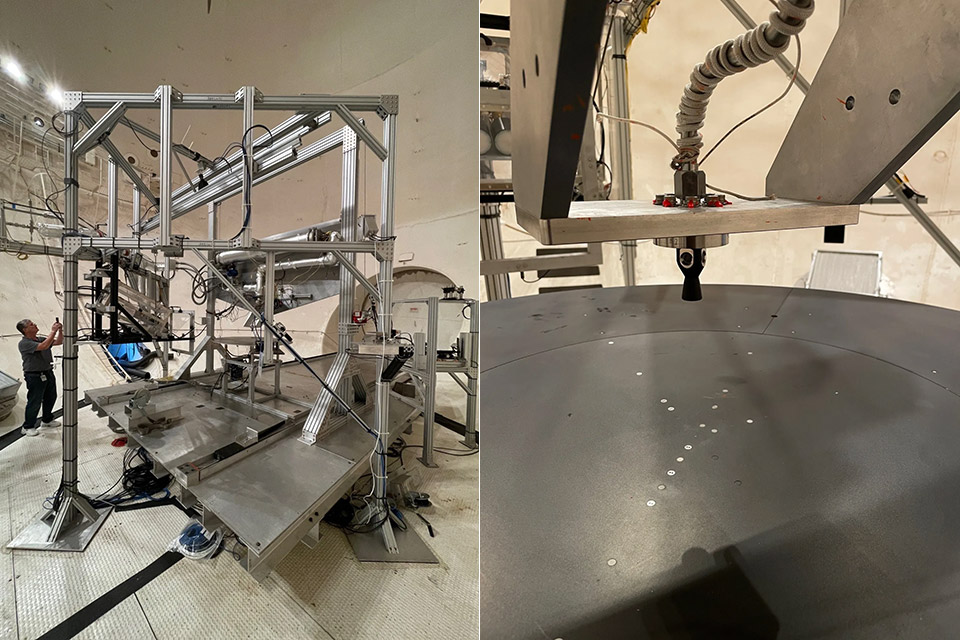
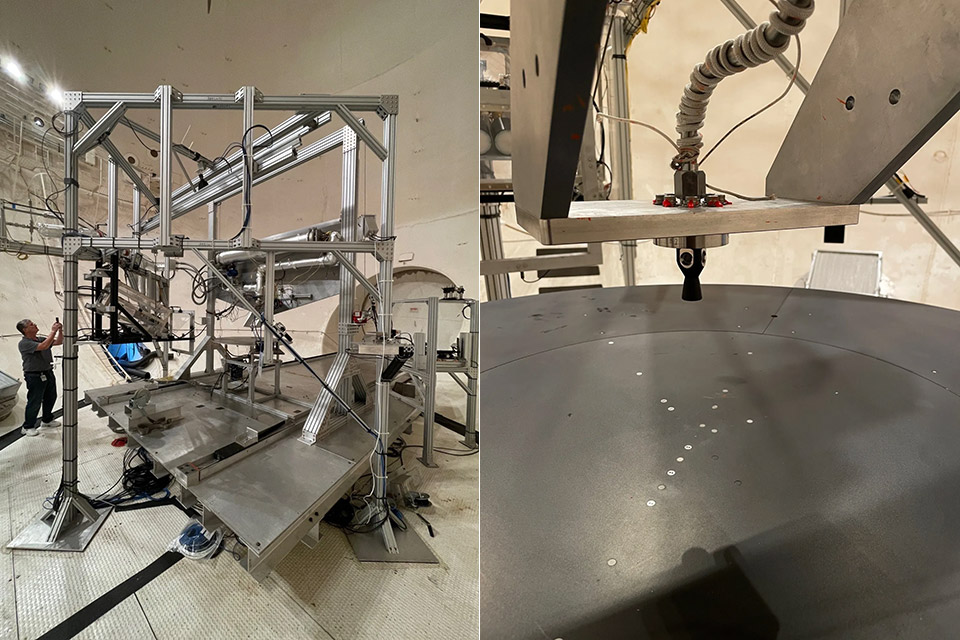
Engineers at NASA’s Langley Research Center in Virginia have activated their massive vacuum chamber to address one of the most pressing issues of landing on the Moon: what happens to the dusty surface when a spaceship touches down. They’re primarily looking at how engine exhaust stirs up the ground, or how all that dust, boulders, and soil gets kicked up high during those few frenetic minutes before landing. They want to sort everything out so that future missions won’t have to deal with the mess. This is especially crucial given that NASA is preparing to send people back to the Moon.
Inside the chamber, the layout resembles that of a high-stakes lab rather than a cutting-edge technology experiment. It’s a 60-foot steel sphere that extracts almost all of the air to imitate the Moon’s near vacuum. Engineers then position nozzles atop a large container of Black Point-1, which is an artificial soil replacement that closely resembles the genuine thing. It has sharp, sticky grains that clump together like the regolith kicked up by the Apollo crew years ago, allowing them to replicate how it behaves in high-stress scenarios. When the nozzles blow for 6 seconds, cameras and sensors are ready to record every detail of the chaos below.
Sale

LEGO Technic NASA Apollo Lunar Roving Vehicle LRV Building Set – Craft Kits for Adults, Ages 18+ -…
- Build a realistic LEGO Technic lunar rover model – This LRV building kit for adults is packed with authentic details including seats, steering,…
- NASA model for adults – Enjoy a mindful project assembling all the details of the rover and equipment including the battery pack, heating and…
- A build for NASA fans – Remember the Apollo 17 mission with a display that features the lunar roving vehicle alongside 3 detailed equipment…
They’re testing two separate engines in the chamber, one after the other. The first to be tested is one that works on ethane gas (which was developed at NASA’s Stennis Space Center in conjunction with Purdue University). It must be capable of generate 100 pounds of force, which is sufficient to raise a full-grown human off the ground, while not burning any fuel or producing flames. This allows the scientists to better observe the cold gas fluxes and understand how they generate particles. Later on, a smaller rocket, only 14 inches wide and precision built 3D-style at Utah State University, has its turn. This hybrid motor uses a combination of solid fuel and oxygen gas to produce 35 pounds of thrust and a jet of hot exhaust. The team is testing it from heights that simulate real-world landing trajectories, gaining a better understanding of the forces at work.
Ashley Korzun leads the testing effort at Langley. She points out the real stakes: “If I’m in a spacecraft and I’m moving all that regolith while landing, some of that’s going to hit my lander. Some of it’s going to go out toward other things — payloads, science experiments, eventually rovers and other assets. Understanding those physics is pivotal to ensuring crew safety and mission success.” Her words cut through the technical haze. Every bit of dust emitted by a lander has the potential to damage solar panels or blind cameras. Worse, it may bury devices used to scout new locations.
Data streams in from a set of equipment that rivals anything NASA has flown previously. Cameras borrowed from Firefly Aerospace’s Blue Ghost lander in March capture high-speed images of craters forming in the soil. Sensors monitor the speed of flying parts, their angles of attack, and the erratic forms that exhaust plumes cut in the airless darkness. Daniel Stubbs, an engineer on the Human Landing System team at Marshall, calls this the most detailed ground run yet. “This test campaign is one of the most flight-relevant and highly instrumented plume-surface interaction test series NASA has ever conducted,” he says. “The data from these tests at NASA Langley will be critical in developing and validating models to predict the effects of plume surface interaction for landing on the Moon and even Mars, ensuring mission success for the human landing systems and the safety of our astronauts.”
NASA’s Latest Bid to Keep Moon Landings Clean Include Plume-Surface Interaction Tests
#NASAs #Latest #Bid #Moon #Landings #Clean #Include #PlumeSurface #Interaction #Tests